luka.zone
An investigative platform documenting political repressions in Belarus and war crimes in Ukraine — built and maintained independently as part of the National Liberation Movement "Para!", whose name references the Mahiliou Uprising of 1661, symbolising the people's readiness to take active steps to reclaim their freedom.
Origin
After the escalation of the war in Ukraine, indiscriminate sanctions were imposed on all Belarusian citizens by state and private companies alike — including Belarusians who had already fled repression at home, only to be punished by nationality-based sanctions in the EU. The absence of tools for targeted, evidence-based sanctioning made it impossible to distinguish perpetrators from victims. luka.zone was built to fill that gap: a structured, searchable database of individuals who have actively contributed to political repression in Belarus or to the war in Ukraine.
What It Does
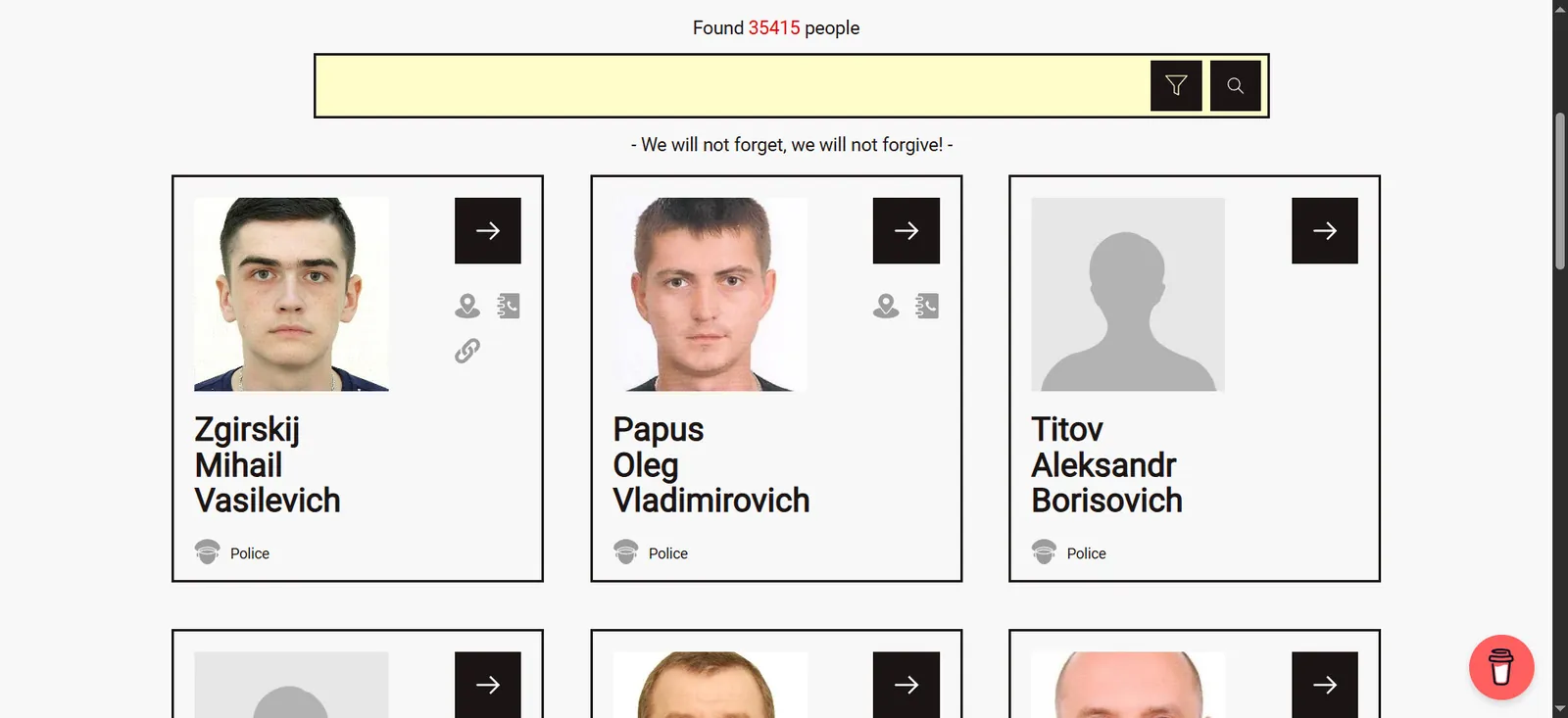
At launch, the database contained approximately 5,000 individuals linked to political repression — compiled from civic initiative lists, open sources, and OSINT tools. Every record is kept in structured form to support search, processing, and downstream use. Users can search by name, phone number, email address, or personal identification number. Full database dumps are available for free download in machine-readable format. A backend-powered admin interface gives vetted partner organisations access to an extended collection of source records — including draft incriminating statements, photos, social media connections, and references.
The greylist-belarus API enables companies to integrate automated screening into their onboarding flows — sending a request on user registration and receiving a notification if a match is found, particularly suited to businesses already running KYC procedures.
Impact & Recognition
Access to luka.zone was blocked inside Belarus in June 2023. In July 2023, the platform's Telegram accounts were added to the national list of extremist materials — a marker of the regime's recognition of the threat it poses. The project was featured in an interview published by the European Students For Liberty in September 2023.
The project was funded personally — over 10,000 EUR and hundreds of hours of development work invested without institutional support, sustained by private donations and a public fundraising campaign.
Plans
Expanding the database, publishing in-depth investigations on listed individuals, growing the partner network of human rights and investigative organisations, and scaling the greylist-belarus API as a practical tool for international companies and crypto exchanges seeking to exclude war criminals and regime collaborators from their platforms.
Visit luka.zone →