The Aid Paradox: What 800 Belarusians Actually Want From Civil Society
A 2024 survey of 800 Belarusians shows that the sectors donors fund most are the ones the public supports least — and the sectors people actually want are the ones nobody funds.
Three decades of Western democracy assistance has produced a Belarusian civil society that is, by most institutional measures, well developed: registered organisations, professional staff, reporting frameworks, international affiliations, conference circuits. It has also produced a civil society that most Belarusians do not ask for.
In July and August 2024 I ran a quantitative study to test that discomfort against data. The question was simple, and — surprisingly — nobody had put it this plainly before: does the supply of foreign aid match the demand of the society it claims to serve?
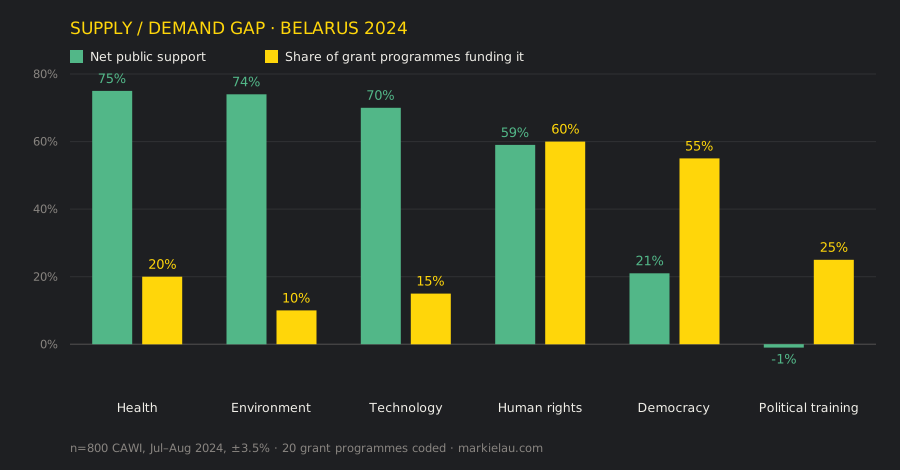
The answer is no. Not marginally, not in the details. The three sectors that attract the most donor money are among the least supported by the public, and the sectors with the broadest public backing are close to unfunded.
How it was measured
The demand side comes from a CAWI (computer-assisted web interviewing) survey of 800 Belarusian respondents, quota-sampled by gender, age and city, with an urban focus (settlements of 5,000+). Confidence level 95%, margin of error ±3.5%. The realised sample was 84% urban, 53% female, with a median age of 41.
Respondents were asked, across 25 thematic areas, whether they supported civic activity in that area. Answers are reported as net support — support minus opposition — so a sector can score negative when more people object than approve.
The supply side comes from an analysis of 20 international grant programmes active in Belarus, coded for whether each of the same 25 thematic areas appears as a funding priority. That yields a “grant presence” percentage per sector: the share of programmes that fund it at all.
Putting the two series side by side produces the gap.
Three patterns
1. Pure NGO-ization — high funding, low support
| Sector | Net public support | Grant presence |
|---|---|---|
| Democracy & governance | 21% | 55% |
| Political training | −1% | 25% |
| Gender equality & LGBTQ+ | −38% | — |
| Migration & refugees | 14% | — |
Political training scores essentially zero net support — as many Belarusians oppose it as back it — while a quarter of grant programmes fund it. Democracy and governance work is funded by more than half of programmes and supported by one in five citizens. Gender equality and LGBTQ+ programming carries −38% net support, the lowest score of all 25 areas. Migration and refugee work reaches only 14%, despite its humanitarian framing.
The reflex explanation is demographic: older, rural, conservative respondents drag the number down, and time is on the donors’ side. The data does not support it. The rejection is homogeneous across gender, age and the urban/rural divide. Respondents aged 18–34 return −28% net support on gender/LGBTQ+ programming. Even in Minsk — the most liberal, most educated, most Westward-facing city in the country — support for democracy funding reaches only 26%.
2. Grassroots neglect — high demand, minimal funding
| Sector | Net public support | Grant presence |
|---|---|---|
| Health | 75% | 20% |
| Environment | 74% | 10% |
| People with disabilities | 74% | 5% |
| Technology & innovation | 70% | 15% |
Three out of four Belarusians support civic work on health, the environment and disability rights. One grant programme in twenty funds disability work. This is not a marginal misallocation; it is the largest single block of unmet civic demand in the country, and it sits in exactly the sectors where an authoritarian state has the least rhetorical ammunition to attack an organisation.
3. Alignment is possible
Human rights: 59% public support, 60% grant presence. Near-perfect alignment. It is the exception, not the rule, but it proves the mismatch elsewhere is not a law of nature — it is a choice about where money goes, and it can be chosen differently.
The undecided are the story
Across the political sectors, the average share of respondents answering “don’t know” is 47%. Almost half the country has no formed opinion about democracy assistance, governance work or political training.
That is not ignorance about politics — Belarusians follow politics closely and at personal cost. It is the residue of a state media environment that has spent years framing civic organisations as foreign-run, and of a civil society that, for structural reasons, has been unable to demonstrate otherwise. The undecided bloc is the actual battleground. It is also the group least likely to be reached by programming that arrives labelled as a foreign political project.
Why this is a structural trap, not a marketing problem
The temptation is to read the mismatch as a communications failure: better messaging, better framing, and the numbers move. They will not, because the incentives that generate the mismatch are structural.
Foreign funding elevates political figures accountable to donors rather than to citizens. It funds media that cannot scrutinise the sources sustaining it. It converts grassroots movements into professionalised NGOs whose priorities are set in funding calls written elsewhere, often imported wholesale from unrelated country contexts, producing mismatches that waste resources. Meanwhile the sector operates under sustained state pressure: the number of registered Belarusian NPOs has fallen 45% from its 2021 peak, to 1,943 organisations. Those that survive depend overwhelmingly on foreign funding. In a given year, 80% of human rights CSOs have secured funding only through the end of the calendar year, and implementing intermediaries absorb — by various estimates — roughly 75% of allocated funds before they reach the ground.
The result is a civil society shaped more by external agendas than by the needs of Belarusians themselves: a pseudo-political ecosystem, representation without a constituency. And every time it visibly fails to match what people say they want, it hands the regime its favourite line for free.
Three things that would change the numbers
-
Move money toward what people support. Health, environment, disability rights, culture, technology. Not instead of rights work — human rights already polls well — but instead of the professionalised political programming that polls at zero.
-
Put Belarusians in charge of allocation. A Belarusian-governed civil society fund, with local decision-making authority over what gets funded, removes the mechanism that produces imported priorities in the first place.
-
Build funding channels that do not require an intermediary. Bitcoin-based microgranting and decentralised distribution platforms cut the 75% overhead and remove the single point the state can seize or pressure.
None of this requires donors to care less about democracy. It requires accepting that in an authoritarian context, legitimacy is the scarce resource — and legitimacy is earned in the sectors where people already want you.
The full study, Realigning Belarusian Civil Society — Give Democracy a Chance, was conducted as Master’s research in Civil Society Studies at ISM University of Management and Economics, Vilnius. Methodology, the complete 25-sector breakdown and the underlying data are published at belarusfreedom.eu.
A follow-up study, planned for 2027, asks the next question: which organisational trust signals actually build public legitimacy in an authoritarian context — and which quietly destroy it.